If you buy corporate bonds, you’ll earn fixed interest that is often higher than a bank FD. In exchange, you accept that the company could fail to pay you back.
That trade-off sits at the heart of every bond. More yield means more risk.
This was once a market for banks and big funds. Ticket sizes have since come down, and many listed bonds now start at around Rs 10,000. Confirm the minimum for any bond you pick.
This guide from AK Investments covers the basics without jargon. You’ll learn:
- How bonds work and how the corporate bond market is organised
- What returns look like, with a worked example
- How to spot the best corporate bonds in India
- How to decide on the best corporate bonds to buy
- The main risks, tax basics, and how to buy online
What Are Corporate Bonds?
A corporate bond is money you lend to a company. It pays you interest for a set period and returns your principal at the end.
Think of it as an FD from a company instead of a bank. The company uses your money to expand, fund projects or repay older loans. You don’t own any part of it, but if it runs into trouble, bondholders are paid before shareholders.
Three terms describe almost every bond:
- Face value: the amount returned at maturity
- Coupon: the yearly interest rate on that face value
- Maturity: the date the loan ends
Summary: A bond is a loan to a company that pays you interest.
How Does the Corporate Bond Market Work in India?
The corporate bond market is where companies borrow from investors by selling debt.
New bonds are sold in the primary market, mostly through private placements and sometimes through public issues. After that, they trade in the secondary market, though some bonds trade rarely. That matters if you need your money back before maturity.
Most individuals reach the corporate bond market through one of three doors:
- A SEBI-registered online bond platform
- A stockbroker, using the NSE or BSE
- A public issue, when a company opens one
Check that any platform you use is registered with SEBI before you sign up.
Summary: Individuals can now enter a market once left to institutions.
What Returns Do Corporate Bonds India Investors Earn?
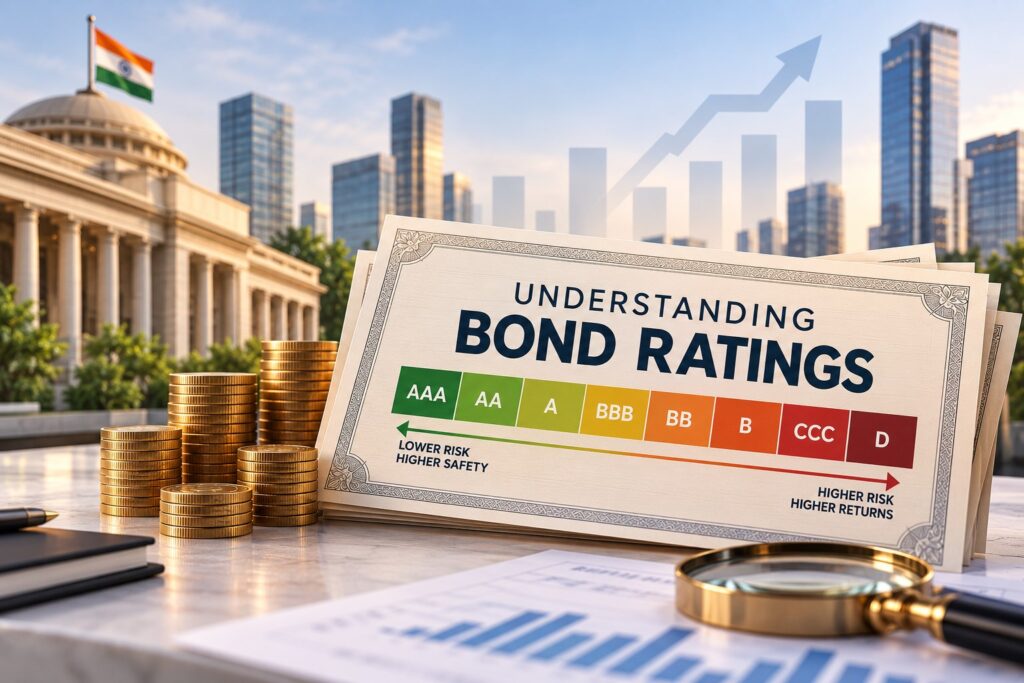
Your return depends on the issuer’s rating and how long you lend. Safer companies pay less, and riskier ones pay more.
Here’s a simple example. Say you buy Rs 50,000 of a bond at face value with a 9% coupon. You’d collect Rs 4,500 in interest each year. That’s only an illustration, so check live rates before you invest.
Also check the yield to maturity (YTM). Unlike the coupon, it accounts for the price you pay and shows what you earn if you hold the bond to maturity.
Rating | Risk | Yield |
AAA | Lowest | Lower |
AA | Low to moderate | Middle |
A and below | Higher | Higher |
Summary: A bigger return is simply payment for carrying more risk.
What Are the Best Corporate Bonds in India?
The best corporate bonds in India come from strong, well-run companies with high credit ratings and a record of paying on time.
There’s no universal winner. A retired couple and a 28-year-old with a steady salary need different things. “Best” means best for you.
A good issuer usually shows these signs:
- A rating of AA or above from CRISIL, ICRA, CARE, or India Ratings
- Steady profits and decent cash flow
- Debt that stays reasonable against earnings
- Assets pledged as security for the bond
- A solid parent group or promoter
Large banks, PSUs, housing finance companies and established infrastructure firms often issue bonds with these traits. Read the offer document before you invest.
Summary: Strong ratings and sound issuers define the best corporate bonds in India.
How Do You Choose the Best Corporate Bonds to Buy?
Pick the best corporate bonds to buy by lining up rating, tenure, and yield with what you need the money to do.
Many new investors sort by coupon and pick the top one. Don’t. A yield well above similar bonds usually signals a weaker borrower.
Work through these steps instead:
- Check the rating and stick to AA or above while you’re learning.
- Compare yield to maturity across similar bonds.
- Match the maturity to when you’ll need the cash.
- Confirm whether the bond is secured by assets.
- Test liquidity by checking how often the bond trades.
- Divide your money across a few issuers.
Summary: The best corporate bonds to buy suit your plan, not the highest number on screen.
What Are the Risks of Corporate Bonds India Investors Face?
The biggest risk in corporate bonds India investors take is a missed interest or principal payment by the issuer.
Other risks are quieter but real:
- Credit risk: the company defaults or its rating is cut
- Interest rate risk: bond prices fall when market rates rise
- Liquidity risk: you can’t find a buyer at a fair price
- Reinvestment risk: interest or principal gets reinvested at lower rates
Research and diversification reduce these risks. Nothing removes them.
Summary: Bonds pay extra because they carry extra risk.
How Are Corporate Bonds Taxed in India?
Interest from corporate bonds is added to your income and taxed at your slab rate.
Selling before maturity can produce a capital gain or loss. For listed bonds held over 12 months, gains are taxed at 12.5% without indexation; for 12 months or less, at your slab rate. Gains on unlisted bonds are taxed at your slab rate, whatever the holding period. TDS of 10% generally applies once interest from an issuer crosses Rs 10,000 in a financial year.
Tax rules change often. Check with a tax advisor what applies to you.
Summary: Your income slab decides the tax on bond interest.
How Do You Buy Corporate Bonds Online?
You can buy a bond online in six steps.
- Pick a SEBI-registered platform or a broker that sells bonds.
- Finish your KYC with PAN, Aadhaar, bank details and a demat account.
- Browse the list and filter by rating, yield, and maturity.
- Read about the issuer, the security, and the payment dates.
- Pay through UPI or net banking.
- Track the bond in your demat account.
AK Investments suggests starting with a small amount. Get comfortable first, then build up.
Summary: Once KYC and demat are in place, buying a bond is straightforward.
Conclusion
Investing in corporate bonds India has to offer can give you steady income and often higher yields than bank FDs. The cost is credit and liquidity risk, which you can manage with high ratings and diversification.
Key takeaways:
- Check the rating and the issuer before every purchase
- Judge the best corporate bonds to buy by yield to maturity and safety, not coupon alone
- Start small and spread your money
When you’re ready to build your fixed-income portfolio, AK Investments can help you choose from the corporate bonds India on offer.
Disclaimer: This is general information, not personalised financial or tax advice. Please consult a SEBI-registered investment adviser before investing.