
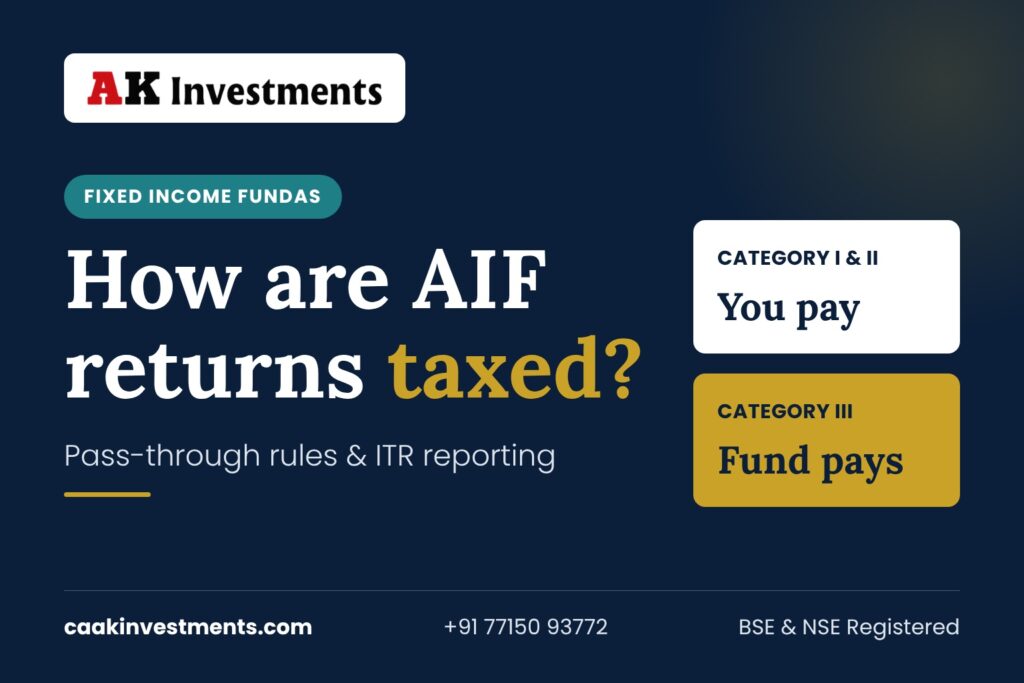
FIXED INCOME FUNDAS
Alternative Investment Funds (AIFs) are not taxed like mutual funds. Depending on the category, either you pay the tax or the fund pays it before you get your money. Here is how it works and what to report in your ITR.
First, the three AIF categories
| Category | What it invests in | Who pays tax |
|---|---|---|
| Category I | Venture capital, angel, SME, infrastructure, social impact funds | You (pass-through) |
| Category II | Private equity, private credit / debt, real estate funds | You (pass-through) |
| Category III | Hedge-fund style strategies, long-short, can use leverage | The fund |
Category I & II: the “pass-through” rule
Under Section 224 of the Income-tax Act, 2025 (old Section 115UB), a Category I or II AIF does not pay tax on its investment income. The income is taxed in your hands, as if you had invested directly.
The income also keeps its nature. Interest stays interest. Capital gains stay capital gains.
| Income earned by the fund | How it is taxed in your hands |
|---|---|
| Interest (e.g. private credit funds) | Your slab rate |
| Dividend | Your slab rate |
| Listed equity, short-term | 20% |
| Listed equity, long-term | 12.5% on gains above ₹1.25 lakh |
| Unlisted shares, long-term | 12.5% |
| Unlisted bonds / debentures | Your slab rate (treated as short-term) |
| Business income | Taxed at fund level; not taxed again in your hands |
From FY 2025-26, gains on securities held by Category I and II AIFs are treated as capital gains, not business income. So in most cases, nearly all income passes through to you.
Tax even if you receive no payout
If the fund earns income but does not distribute it, that income is treated as credited to you on the last day of the tax year. You owe tax on it that year, even without any cash in hand.
TDS is only the first instalment
The fund deducts 10% TDS on taxable income paid or credited to resident investors under Section 393(1) (old Section 194LBB). There is no minimum threshold. If you are in a higher slab, the balance is payable by you.
Example: Category II private credit fund
Investment: ₹1 crore
Interest earned by the fund for your units: ₹11 lakh
TDS deducted by the fund (10%): ₹1,10,000
Tax at 30% slab + 4% cess: ₹3,43,200
Balance tax you pay: ₹2,33,200 (before any surcharge)
What happens to losses
- Business losses stay with the fund. They do not pass to you.
- Other losses (such as capital losses) pass to you only if you have held the units for at least 12 months.
Category III: tax paid by the fund
Category III AIFs are outside the pass-through rule. The fund pays tax on its income, and you receive post-tax payouts, which are generally not taxed again.
- Capital gains are generally taxed at capital gains rates (with surcharge) where the trust is a determinate trust.
- Business income, such as from futures and options, is taxed at the maximum marginal rate.
- Your own lower slab rate does not apply, and fund losses cannot be set off against your other income.
Category I & II You pay tax on your share of income, at rates based on income type. Report it in your ITR. | Category III Fund pays tax. You receive post-tax payouts. Your slab rate and loss set-off do not apply. |
ITR reporting: step by step
1. Collect the fund’s statement. The fund issues Form 78 (old Form 64C) by 30 June. It shows your income under each head and the TDS deducted.
2. Match it with your AIS. Check that the income and TDS in your Annual Information Statement match the fund’s statement.
3. Fill Schedule PTI. Report pass-through income from the investment fund under each head: interest, dividend, short-term and long-term capital gains.
4. Claim the TDS credit. The 10% deducted by the fund is adjusted against your final tax.
5. Pick the right form. ITR-1 and ITR-4 do not have Schedule PTI. ITR-2 is used in most cases; ITR-3 if you have business income.
6. Pay advance tax. If tax after TDS exceeds ₹10,000, pay it in quarterly instalments to avoid interest.
Which law applies?
Income for FY 2025-26 (earned up to 31 March 2026) follows the Income-tax Act, 1961: Form 64C and Section 115UB. Income from tax year 2026-27 (from 1 April 2026) follows the Income-tax Act, 2025: Form 78 and Section 224. The tax treatment is the same; the section and form numbers changed.
Key takeaways
- Category I & II AIFs: you pay the tax; income keeps its original nature.
- You may owe tax on income the fund has not paid out.
- 10% TDS is not the final tax for higher-slab investors.
- Category III AIFs: the fund pays tax; payouts are generally not taxed again.
- Use Form 78 / Form 64C and your AIS to fill Schedule PTI correctly.
Have an AIF in your portfolio, or considering one?
Talk to AK Investments: +91 77150 93772 | caakinvestments.com
Disclaimer: This article is for investor education only and is not tax, legal or investment advice. Tax rates mentioned exclude surcharge unless stated and are based on rules in force as of November 2026; they may change. Tax treatment depends on your individual facts. Please consult your tax adviser before acting. AIF investments are subject to market risks; read all scheme-related documents carefully. AK Investments | BSE & NSE Registered | AMFI ARN 325213.