
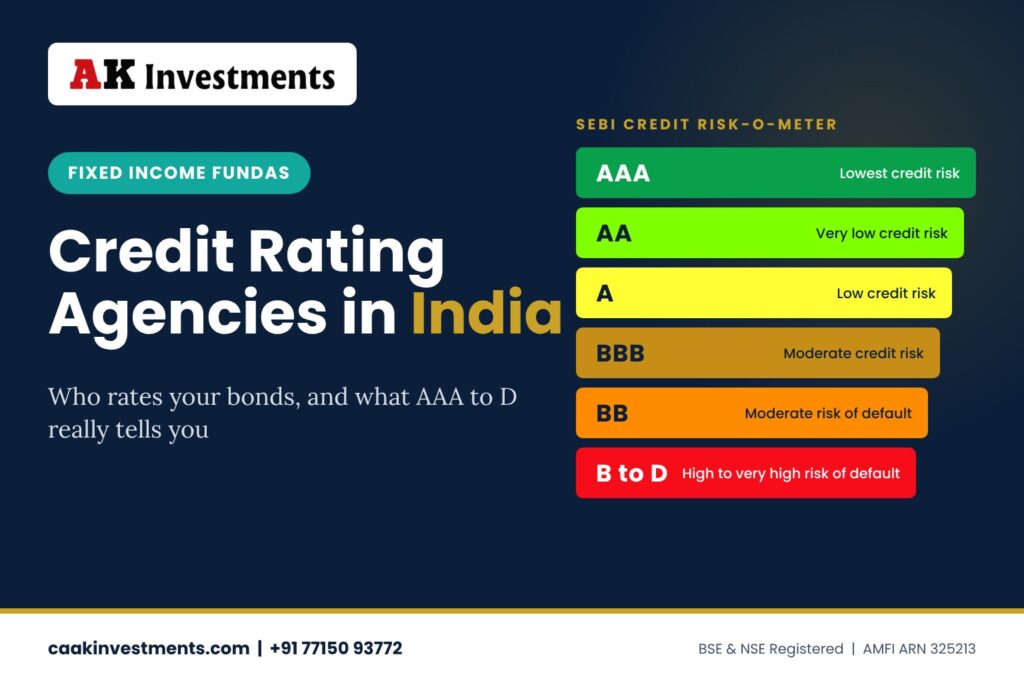
FIXED INCOME FUNDAS
Credit Rating Agencies in India: Who Rates Your Bonds and Why It Matters
Before you buy a bond or an NCD, you will see a short code next to it: AAA, AA+, A-, BBB. That code is a credit rating. It is the quickest way to judge one question that matters more than the interest rate itself: how likely is the company to pay you back, on time and in full?
Most retail investors cannot read a company’s balance sheet line by line or meet its management. Credit rating agencies do this work and publish their view for the whole market. Here is how they work, who they are, and how to use their ratings sensibly.
What is a credit rating?
A credit rating is an independent opinion on the credit risk of a borrower or a specific debt instrument. It indicates the likelihood that interest and principal will be paid on time.
Two types are worth knowing:
- Issuer rating – the overall financial strength of the company borrowing the money.
- Instrument rating – the rating of one particular bond or NCD. It depends on the bond’s structure, whether it is secured, and its priority in repayment.
This is why the same company can have different ratings on different bonds. A secured bond may be rated higher than an unsecured or subordinated bond from the same issuer.
Reading the rating scale
Indian agencies use broadly similar long-term symbols:
- AAA – highest degree of safety
- AA – high degree of safety
- A – adequate degree of safety
- BBB – moderate safety; the lowest investment-grade band
- BB, B, C – speculative grade; higher risk of default
- D – in default, or expected to default soon
A “+” or “-” shows the position within a band, so AA+ sits just above AA. Ratings also carry an outlook, such as Stable, Positive or Negative, which signals the likely direction of the rating over the medium term.
Who are India’s credit rating agencies?
Credit rating agencies in India are registered with and regulated by SEBI under the SEBI (Credit Rating Agencies) Regulations, 1999. As per SEBI’s Annual Report 2025-26, eight agencies were registered as of 31 March 2026:
- CRISIL Ratings – India’s first rating agency (1987), part of the S&P Global group.
- ICRA – set up in 1991; an affiliate of Moody’s. Strong in infrastructure and financial sector ratings.
- CARE Ratings (CareEdge) – set up in 1993; promoted by Indian financial institutions, with depth in manufacturing, infrastructure and MSMEs.
- India Ratings & Research – a Fitch Group company covering corporates, banks, insurers, structured and project finance.
- Acuité Ratings & Research – formerly SMERA; focused on small and mid-sized companies.
- Brickwork Ratings – rates bonds, bank loans and fixed deposits.
- Infomerics Valuation and Rating – serves mid-sized corporates and specialised segments.
- Acer Credit Rating – the newest entrant, registered with SEBI in August 2025.
CRISIL, ICRA and CARE are themselves listed companies. SEBI’s annual report also shows that agencies rated 725 new debt issuances in 2025-26, with CRISIL accounting for close to half of them.
How do agencies arrive at a rating?
Rating analysts look at both numbers and judgement:
- Financial strength – cash flows, debt-to-equity, interest coverage and liquidity.
- Business risk – industry cycles, competition and the company’s market position.
- Management quality – track record, governance and funding access.
- Instrument structure – security cover, guarantees and repayment priority.
Ratings are reviewed at least once a year, and earlier if something material changes. A downgrade can happen at any time during the life of a bond.
Why ratings matter for bonds and NCDs
- Mandatory for public issues – under SEBI rules, a public issue of debt securities must be rated by at least one SEBI-registered agency.
- Dual ratings – larger issues often carry ratings from two agencies, giving investors a second view.
- Price of risk – a higher rating usually means a lower coupon; a lower rating means the issuer pays more to attract investors.
- Wider regulatory use – RBI uses ratings for bank capital norms and SEBI uses them for mutual fund investment limits.
How should you use a rating?
Treat the rating as a starting point, not the final answer. A few practical rules:
- Match the rating to your risk appetite. AAA and AA bonds suit capital preservation; A and BBB bonds offer higher yields with higher credit risk.
- Check the outlook and the rating date. A recent “Negative” outlook deserves attention.
- Read the rating rationale. Agencies publish a short note explaining the key strengths and risks.
- Spread money across issuers and rating bands rather than one bond.
- Remember ratings can change. A rating is an opinion based on information available today, not a guarantee of repayment.
Frequently asked questions
Q. Is a AAA-rated bond risk-free?
No. AAA indicates the highest degree of safety among corporate bonds, but ratings can be downgraded and defaults, while rare at this level, are possible.
Q. What is investment grade?
Bonds rated BBB- and above are called investment grade. Bonds rated BB+ and below are speculative grade and carry a higher risk of default.
Q. Why do two agencies sometimes give different ratings?
Each agency uses its own methodology and judgement. A gap between two ratings on the same bond is worth understanding before you invest.
Q. Who pays for a credit rating?
In India, the issuer usually pays the agency. SEBI regulations require agencies to manage this conflict of interest and to disclose their methodologies and rating rationales.
Q. Where can I find a bond’s rating?
In the offer document, on the rating agency’s website, and on the bond listing pages of caakinvestments.com, where each bond shows its rating alongside coupon, YTM and maturity.
Want to compare bonds by rating, yield and tenure? Use the Bond Calculator on caakinvestments.com or call AK Investments on +91 77150 93772.
Sources: SEBI Annual Report 2025-26 (Chapter 7, Credit Rating Agencies); SEBI (Credit Rating Agencies) Regulations, 1999.
Disclaimer: This article is for investor education only and does not constitute investment advice or a recommendation to buy or sell any security. Credit ratings are opinions of rating agencies and are not guarantees of repayment. Investments in corporate debt securities carry credit, market and default risks, including delay and/or default in payment. Read all offer-related documents carefully before investing. Fixed returns are not guaranteed or assured.