
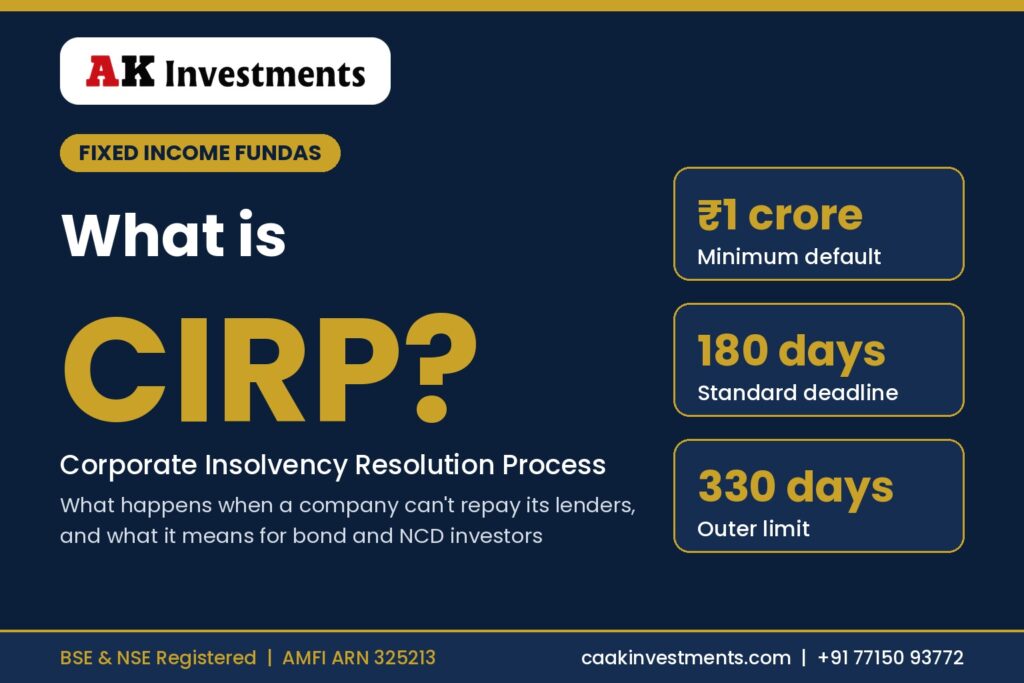
What is CIRP? A Simple Guide for Bond and NCD Investors
Understand the Corporate Insolvency Resolution Process in plain language
When a company borrows from banks, bondholders or suppliers and can no longer repay them, India has a fixed legal route to deal with it: CIRP under the Insolvency and Bankruptcy Code (IBC), 2016. If you invest in bonds or NCDs, this is the process that decides what happens to your money after a default.
What is CIRP?
CIRP stands for Corporate Insolvency Resolution Process. Think of it as an ICU for a sick company: instead of shutting it down right away, creditors get a fixed window to find a buyer who can revive it and repay as much as possible.
| Aspect | Key Detail |
| Law | Insolvency and Bankruptcy Code (IBC), 2016 |
| Where the case is heard | National Company Law Tribunal (NCLT) |
| Regulator | Insolvency and Bankruptcy Board of India (IBBI) |
| Minimum default | ₹1 crore |
Who Can Start CIRP?
- Financial creditors such as banks, NBFCs and bondholders (Section 7)
- Operational creditors such as suppliers, after a 10-day demand notice (Section 9)
- The company itself (Section 10)
Who Runs the Company?
Promoters lose control once CIRP begins. An Interim Resolution Professional (IRP), later confirmed or replaced as the Resolution Professional (RP), runs the company. Big decisions are taken by the Committee of Creditors (CoC), made up mainly of lenders, with votes weighted by the amount owed.
The Process in 5 Steps
- Admission: The NCLT admits the case and a moratorium freezes all recovery actions.
- Claims: The IRP invites claims from all creditors through a public notice.
- CoC formed: Verified lenders form the Committee of Creditors.
- Plans invited: Buyers submit resolution plans; the CoC approves one with 66% of the vote.
- NCLT approval: The approved plan becomes binding on everyone.
CIRP Timeline at a Glance
| Stage | Indicative Timing |
| Case admitted, moratorium starts | Day 0 |
| Public announcement inviting claims | Within 3 days |
| Committee of Creditors formed | Around Day 30 |
| Standard deadline | 180 days |
| One-time extension (66% CoC vote) | Up to 90 days |
| Outer limit, including court time | 330 days |
Note: In practice, many cases have taken longer because of litigation.
How Does CIRP End?
Either a buyer’s plan is approved and the company continues under new owners, or, if no plan works out in time, the NCLT orders liquidation (Section 33). The assets are then sold and creditors are paid in a fixed order of priority (Section 53).
What CIRP Means for Bond and NCD Investors
If you hold bonds or NCDs of a company that enters CIRP, here is what you should know:
- You are a financial creditor. As a bondholder or NCD holder, you have lent money to the company. This places you among the financial creditors who sit on the CoC.
- The debenture trustee acts for you. Individual investors usually do not attend meetings. The debenture trustee files claims and represents NCD holders in the process.
- Payments stop. Once the moratorium begins, interest and principal payments on your bonds are frozen until the case is resolved.
- Recovery is often partial. Creditors often recover only a part of what they are owed. The final amount depends on the plan a buyer offers. This cut is called a “haircut”.
- Secured beats unsecured. Secured NCDs are backed by company assets and rank higher in the liquidation waterfall. Unsecured and subordinated bonds rank lower and usually recover less.
- It takes time. Even with timelines in the law, your money may stay locked for many months, sometimes years.
| Funda to Remember Before buying any bond or NCD, check the credit rating, whether it is secured, what security backs it, and who the debenture trustee is. Spread your money across issuers instead of putting it all in one. A high coupon often signals higher risk. |
Frequently Asked Questions
1. What is the full form of CIRP?
Corporate Insolvency Resolution Process, under the IBC.
2. How long does CIRP take?
180 days, extendable once by 90 days, with an outer limit of 330 days including court time.
3. Can promoters run the company during CIRP?
No. Control moves to the IRP or RP, and the Committee of Creditors takes major decisions.
4. Will I get my full money back as an NCD holder?
Not always. Recovery depends on the approved plan or the asset sale, and is often less than the amount owed.
Conclusion
CIRP gives a struggling company a fixed window to be revived, with creditors in charge. For bond and NCD investors, it is a reminder that fixed income carries credit risk, and that checking quality and security matters as much as the coupon.
Have questions about bonds or NCDs? Talk to the team at AK Investments — caakinvestments.com | +91 77150 93772.
Disclaimer
This article is for investor education only and does not constitute investment, legal or tax advice, or a recommendation to buy or sell any security. Investments in bonds and NCDs are subject to credit, interest rate and liquidity risks. Please read all offer documents carefully and consult your advisor before investing. Information is based on the Insolvency and Bankruptcy Code, 2016, as understood at the time of writing, and may change.
BSE Reg. No. AP01673301178592 | NSE Reg. No. AP3086050151 | AMFI ARN 325213