
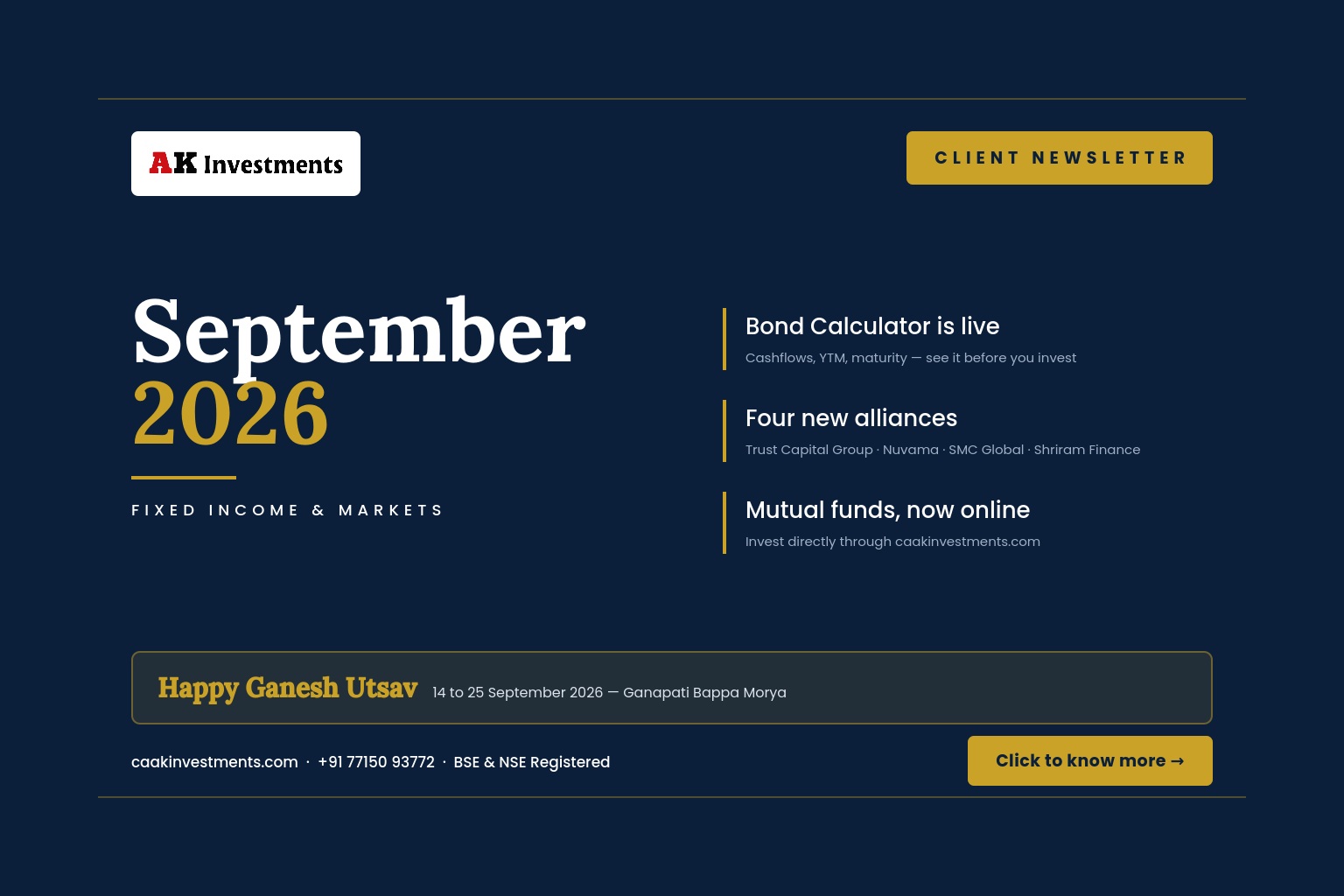
Newsletter – September 2026 Edition
Bond Calculator now live, four new fixed income alliances, and our September outlook on Indian bonds — repo at 5.25%, 10-year G-Sec near 7%. Read the edition.
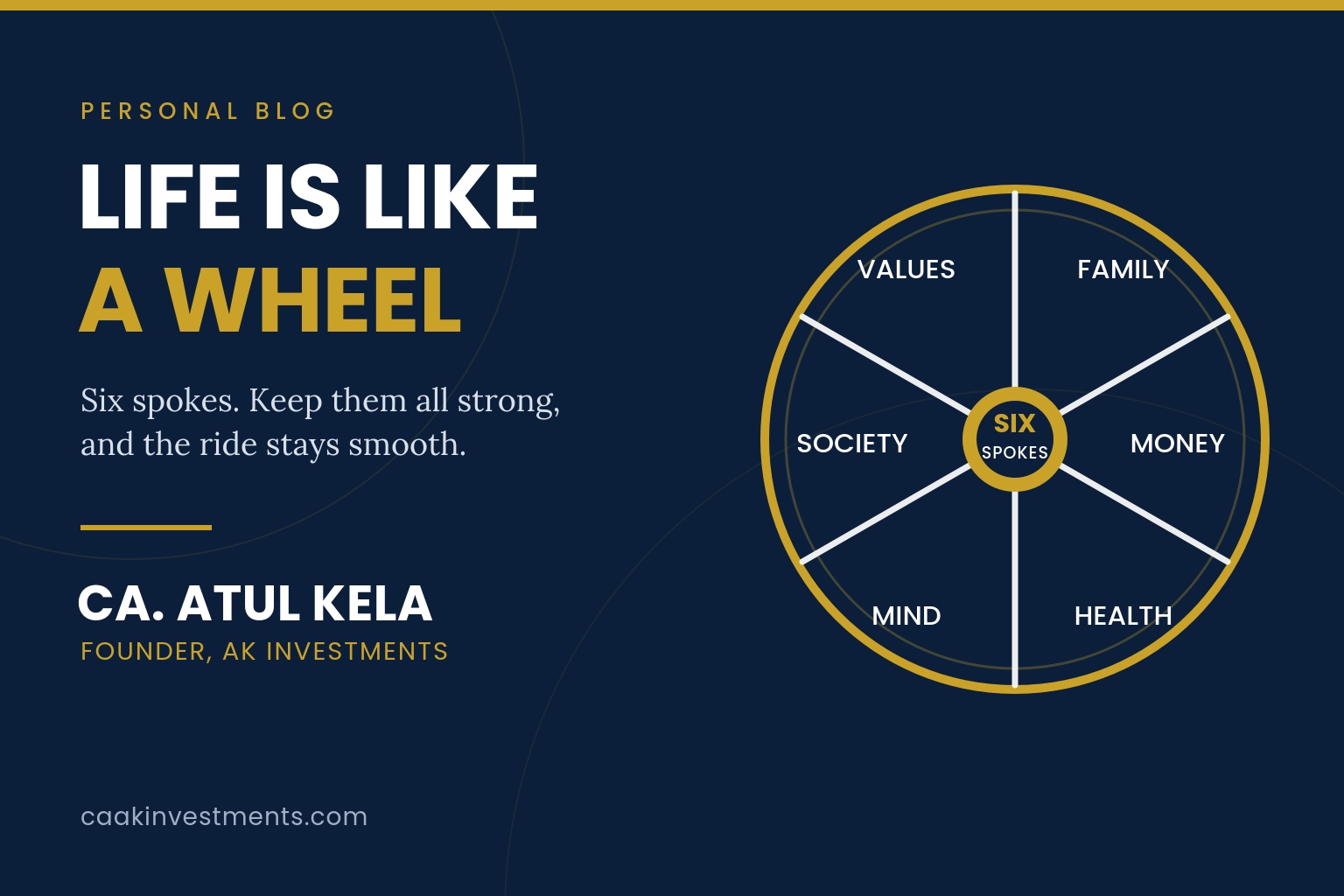
Life Is Like a Wheel – Six spokes
Understand why Life is like a Wheel with six spokes. Strengthen each spoke to enjoy a more balanced and fulfilling life.

Newsletter – August 2026 Edition
Our August 2026 newsletter is out. Inside: our new association with Choice International — opening up MLDs, AIFs and Corporate FDs alongside secured bonds; the launch of Fixed Income Fundas, our educational series; a ₹1 crore+ month for the second time running; and a round-up of what the RBI and SEBI announced this month for the fixed income market.
Newsletter – July 2026 Edition
Building Wealth Through Discipline, Diversification & Stability
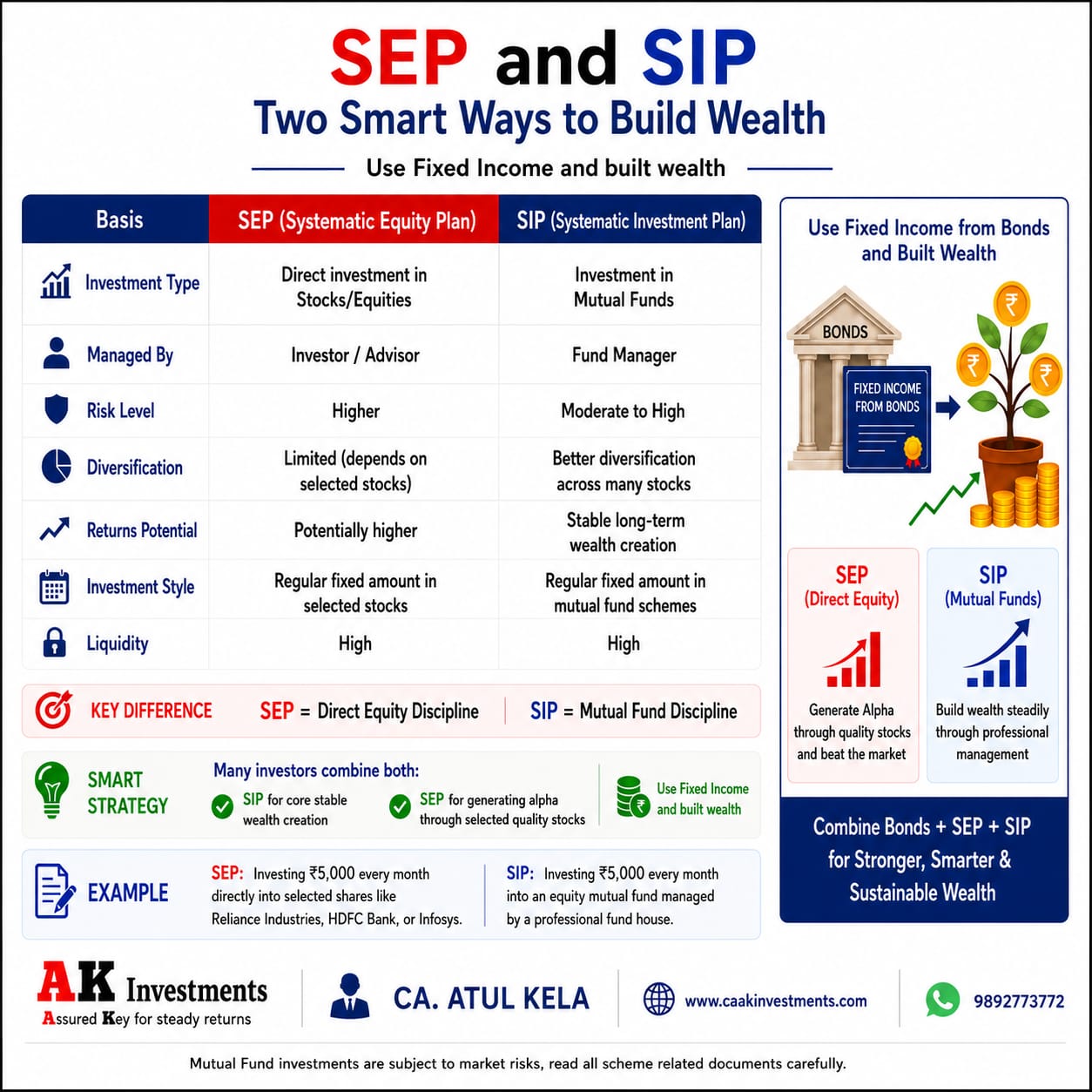
SEP and SIP: Two Smart Ways to Build Wealth
SEP and SIP: Two Smart Ways to Build Wealth Published by AK Investments | www.caakinvestments.com Why Discipline Beats Timing — Every Time Most investors spend years waiting for the “right moment” to invest. The truth? The right moment is now — and the right method matters more than market timing. At AK Investments, we believe in two powerful, disciplined approaches to growing your wealth: the Systematic Equity Plan (SEP) and the Systematic Investment Plan (SIP). Each serves a distinct purpose, and together — combined with the stability of fixed income from bonds — they form a complete, robust wealth-building strategy. What Is a Systematic Equity Plan (SEP)? A SEP is a structured approach to investing directly in stocks and equities. Think of it as bringing the discipline of a fixed monthly commitment to the world of direct equity investing. How it works: You invest a fixed amount — say, ₹5,000 every month — directly into selected shares like Reliance Industries, HDFC Bank, or Infosys. You (or your advisor) choose the stocks, manage the portfolio, and adjust as needed. Key characteristics: Investment type: Direct stocks and equities Managed by: You, or a trusted investment advisor Risk level: Higher (concentrated in selected stocks) Diversification: Limited — depends on your stock selection Returns potential: Potentially higher than average, with the ability to generate alpha Liquidity: High Investment style: Fixed regular amounts into chosen stocks Best for: Investors who want direct market participation, are comfortable with higher risk, and aim to beat the market through stock selection. What Is a Systematic Investment Plan (SIP)? A SIP lets you invest a fixed amount every month into mutual funds — professionally managed portfolios that spread your money across many stocks, bonds, or other assets. How it works: You invest ₹5,000 every month into a mutual fund scheme. A professional fund manager handles the selection and rebalancing on your behalf. Key characteristics: Investment type: Mutual funds Managed by: A professional fund manager Risk level: Moderate to high Diversification: Strong — spread across many stocks automatically Returns potential: Stable, long-term wealth creation Liquidity: High Investment style: Fixed regular amounts into mutual fund schemes Best for: Investors who want professional management, broad diversification, and steady, long-term wealth accumulation without active involvement. SEP vs. SIP at a Glance Basis SEP (Systematic Equity Plan) SIP (Systematic Investment Plan) Investment Type Direct stocks & equities Mutual funds Managed By Investor / Advisor Professional fund manager Risk Level Higher Moderate to high Diversification Limited Better — across many stocks Returns Potential Potentially higher (alpha) Stable long-term growth Investment Style Fixed amount in selected stocks Fixed amount in fund schemes Liquidity High High The key difference: SEP follows Direct Equity Discipline. SIP follows Mutual Fund Discipline. The Smart Strategy: Why Not Both? Many of our clients use SEP and SIP together — and for good reason. They complement each other beautifully. SIP forms the core of your portfolio, providing stable, diversified wealth creation with professional oversight. SEP adds a performance layer, targeting alpha — returns above the market average — through carefully selected quality stocks. Bonds provide the stable fixed income foundation, reducing overall portfolio volatility. Together: Bonds + SEP + SIP = Stronger, Smarter & Sustainable Wealth. This combination gives you the stability of bonds, the market-beating potential of direct equity, and the diversification of professional fund management — all working in concert. Practical Examples SEP in action: Investing ₹5,000 every month directly into shares of companies like Reliance Industries, HDFC Bank, or Infosys — building a personal equity portfolio with the guidance of your advisor. SIP in action: Investing ₹5,000 every month into an equity mutual fund managed by a reputable fund house — letting professionals do the research, selection, and rebalancing for you. Starting Your Wealth Journey The best investment strategy is one you can stick to consistently. Whether you start with a SIP, a SEP, or both, the discipline of regular investing — month after month — is what truly builds wealth over time. Ready to take the next step?

BEHAVIOUR WILL DEFINE WEALTH IN 2026, NOT MARKETS
BEHAVIOUR WILL DEFINE WEALTH IN 2026, NOT MARKETS How Sachin Tendulkar decision helped him? Sachin Tendulkar, arguably the greatest batsman of all time, hit a rough patch in 2003-04. He was repeatedly getting out to deliveries outside the off stump, especially while playing the cover drive, his signature and most fluent stroke. After 13 innings without a century, he made a conscious and counter-intuitive decision in the Sydney Test of 2004: he would not play the cover drive at all. The result was an unbeaten and masterful 241 against a formidable Australian attack. His ability to suppress instinct for nearly ten hours reflected immense clarity, discipline, and mental fortitude. Equity market 2026 The equity markets in 2026 may test investors in a similar way. When instinct drives us toward quick, impulsive reactions, it is behavioural discipline, steady restraint, and clarity of purpose that will truly determine outcomes. Markets may remain active and even unpredictable, but investor reactions will matter more. The past year made it clear that we are now operating in a sharply polarised global environment, one actively reshaping policies, fluctuating flows, currencies, and commodities. For the first time, global reserves in gold have surpassed reserves in the US dollar, marking a significant structural shift in how nations perceive security and long-term value. At a time when gold has clearly outperformed broad equity returns over a 10-year horizon, it is worth considering whether we should continue to view it solely as a traditional hedge. Meanwhile, new public issues have largely emerged from the mid- and small-cap segments. Allocating disproportionately to large caps may therefore result in a portfolio that fails to accurately represent the true breadth and depth of the evolving markets. Interest rates too remain higher than in the pre-Covid period, suggesting that the traditional approach to long-term debt investing now needs careful re-examination. Yet corporate earnings, spending patterns, and capex have not shown any meaningful deviation, making it difficult to pinpoint the next clear trigger for equity markets. How wealth and a strong portfolio created? 95% of wealth is created through asset allocation, and only 5% through market movements, while 95% of conversations tend to focus on the latter. The investor who consciously shifts this narrative toward asset allocation and risk balance will be better positioned to create a stronger and more resilient portfolio. Portfolios of the past may not be the portfolios of the future, and revisiting the underlying assumptions is therefore essential in navigating an evolving landscape. Interestingly, the inherent behavioural tendency of Indian households to hold gold has helped them create steady wealth over time, offering a clear example of how consistent behaviour compounds quietly but meaningfully. In a changing global order, asset allocation is still the key to building most of your wealth To act or not to act According to AMFI analysis, nearly four in ten Indian investors do not stay invested in equities for more than 24 months, often exiting before compounding has any real chance to work. Two years is too short a horizon for wealth creation in equities. Emotional responses driven by news flow, temporary price movements, or fear of loss often interrupt long-term potential. In investing, perseverance and patience are not passive traits; they are active decisions. Just as Tendulkar chose not to play the cover drive, investors sometimes need to choose not to react to every movement. The discipline of staying the course can be more powerful than the sophistication of any strategy. Systematic investing, thoughtful asset allocation, periodic rebalancing, and staying aligned with one’s financial goals remain critical. Market cycles can change every year, sometimes every quarter. But clarity of behaviour is what compounds. In 2026, the most valuable asset may not be an asset class it may be investor behaviour. As India deepens its financial participation, the next phase of maturity will be shaped not just by access and awareness but by behaviour how investors respond, absorb, and stay committed through changing market conditions. And sometimes, as Tendulkar showed us in Sydney, the best shot you play is the one you don’t. Conclusion In 2026, investor behaviour will be more crucial than market movements in determining wealth creation. While markets may remain active and unpredictable, disciplined behaviour, restraint, and clarity of purpose will be key. Asset allocation, risk balance, and a focus on long-term goals will be essential for building a resilient portfolio. Courtesy to Swarup Anand Mohanty, Vice Chairman and CEO, Mirae Asset Investment Managers (India), for where I have extracted the content of this article and found to be relevant.

The Anxiety of the Salary Day & When Can You Stop Working for the Salary
The Anxiety of the Salary Day & When Can You Stop Working for the Salary The article “The Anxiety of the Salary Day & When Can You Stop Working for the Salary ” explores how important it is to channelise your finances in the right investment bucket without which the lifestyle pressures may lead to anxiety at the payday. Research shows that over 65% of individuals identify money as their main source of anxiety, leading to reduced productivity, decision fatigue, and mental exhaustion. This article emphasizes that financial wellness programs, budgeting, investment education, and behavioural coaching can help individuals regain control and reduce dependence on the next paycheck. Through structured planning, emergency funds, SIPs, and professional financial advice, individuals can transition from financial anxiety to confidence—achieving true freedom from working merely for the salary. What Salary Day Anxiety Means, Its Impact, and How It Can Be Addressed Normally, when a topic like this comes, we salaried class tend to either overlook or sidetrack as we don’t think we can get out of this cycle. What we do not realize is that it carries not just financial risk but also behavioural impact on the finances; thus, understanding the anxiety that all salaried class feel becomes important. And this might not necessarily come due to poor decision making but also lifestyle maintenance. Understanding Salary Day Anxiety Salary Day Anxiety refers to the stress and unease employees experience around the day their salary is credited. It is not simply about whether the salary arrives on time, but the emotional burden linked to financial stability and lifestyle maintenance. Even employees earning well can feel anxious because salary represents a sense of safety and survival. The brain anticipates the reward of a credited salary, and this anticipation can trigger restlessness and worry. Impact of Salary Day Anxiety The effects extend far beyond financial stress: Mental Health Strain: Persistent concerns can lead to anxiety, depression, and decision fatigue. Behavioural Changes: Employees may take more leaves to manage financial crises, and cognitive energy is diverted away from work. Cross-Level Effect: Both entry-level staff with limited savings and senior executives maintaining high lifestyles experience this anxiety Reduced Productivity: Worrying about finances distracts employees, lowers focus, and hampers performance. Organisational Impact: High levels of financial stress can affect employee engagement, morale, and overall workplace performance. How Salary Day Anxiety Can Be Addressed Goal-Based and Automated Savings: Set clear financial goals and adopt systematic investment plans (SIPs) to ensure consistent progress. Follow the ‘The Turtle Theory – You don’t have to move fast. You just have to keep moving – with patience, direction and peace. Progress doesn’t need speed. Its needs consistency’ Investment Education & Behavioural Coaching: Attend workshops and counselling to understand risk in various investment avenues, avoid panic, and build financial confidence. Comprehensive Financial Planning: Creation of a diversified plan with budgeting, debt management, savings, and insurance reviews. Emergency Fund Creation: Maintain reserves that cover 6–12 months of expenses to cushion against uncertainties. Professional Financial Support: Consult certified advisors to personalise strategies, conduct regular portfolio reviews, and ensure proper insurance coverage. By combining practical financial tools with psychological resilience, individuals can reduce Salary Day Anxiety, improve financial wellbeing, and enhance overall productivity. Structured planning not only alleviates payday stress but also paves the way for true financial independence. Courtesy to Shri. Abhishek Dev, CEO Epsilon Money, from where I have extracted some content and linked to what I feel and experienced.
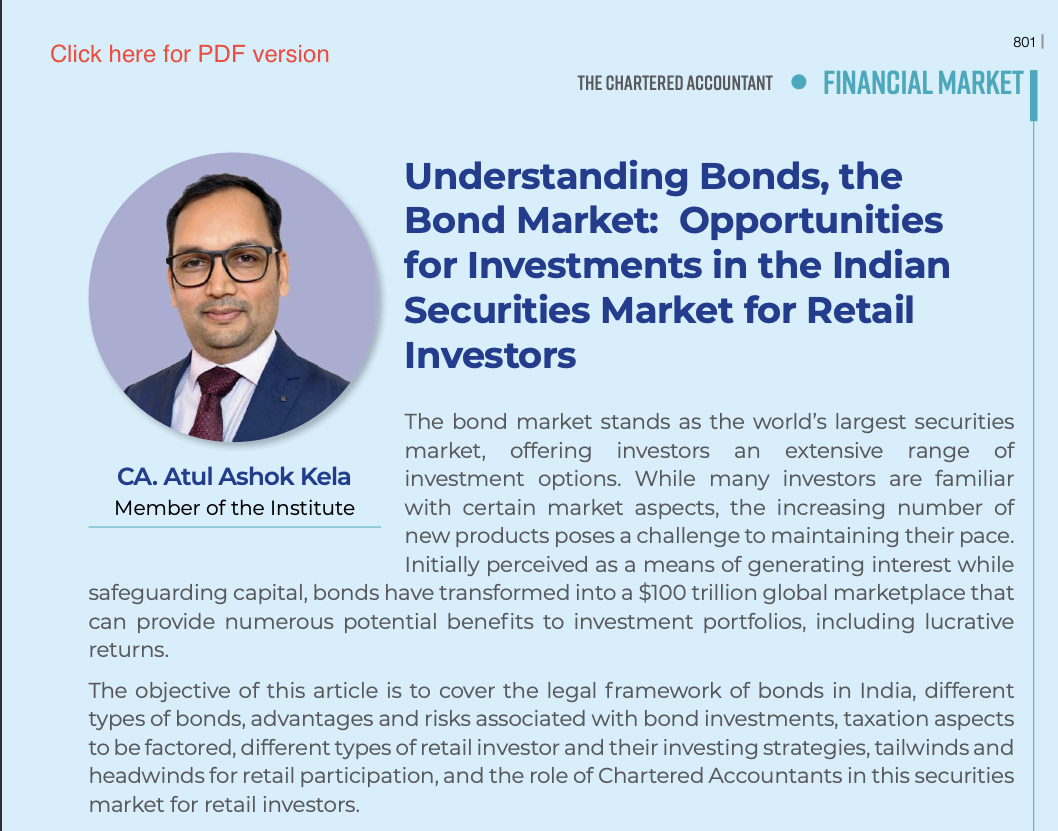
Understanding Bonds, the Bond Market: Opportunities for Investments in Indian Securities Market for Retail Investors
The bond market is by far the largest securities market in the world, providing investors with virtually limitless investment options. Many investors are familiar with aspects of the market, but as the number of new products grows, it is challenged to keep pace. Once viewed as a means of earning interest while preserving capital, bonds have evolved into a $100 trillion global marketplace that can offer many potential benefits to investment portfolios, including attractive returns. The objective of this article is to covers the legal framework of bonds in India, different type of bonds, advantages and risk associated with the bond investments, taxation aspects to be factored, tailwinds and headwinds for retail participation and role of Chartered Accountants in this securities market for retail investor

Gold ETF vs Physical Gold 2025 – Which is Better?
Gold ETF vs Physical Gold 2025 – Which is Better? In 2025, gold continues to be one of the most trusted and widely used investment options in India. However, the debate between gold ETF vs physical gold 2025 is more relevant than ever. While physical gold has cultural and traditional value, gold investment types like Exchange-Traded Funds (ETFs) offer convenience, transparency, and cost efficiency. Both investment forms have their own benefits and drawbacks. The right choice depends on factors such as investment goals, liquidity needs, and risk tolerance. Understanding Gold ETFs A gold ETF is a financial instrument that tracks the market price of gold and is traded on stock exchanges like shares. Instead of holding gold in physical form, investors own units representing a certain quantity of gold. Key Features of Gold ETFs: Traded like stocks on exchanges. Backed by gold of 99.5% purity or higher. Stored securely by fund custodians, eliminating storage risks. Requires a Demat account for trading. For investors looking at gold investment without the hassles of storage and safety, ETFs are a convenient choice. Understanding Physical Gold Physical gold includes coins, bars, and jewellery purchased from jewellers, banks, or authorised dealers. It has cultural importance in India, often associated with weddings, festivals, and gifting. Key Features of Physical Gold: Tangible asset with sentimental value. Available in various forms and weights. Can be pledged for loans. Immediate ownership without a trading account. While physical gold satisfies emotional and cultural needs, it involves additional costs and risks. Comparing Gold ETF vs Physical Gold in 2025 Here’s a detailed comparison of these two gold investment types: Feature Gold ETF Physical Gold Liquidity High – Can be sold anytime on exchanges Medium – Selling may take time Purity Assurance Guaranteed (99.5%+) Varies depending on source Storage & Security No storage required Needs secure storage, risk of theft Additional Costs Low – Brokerage and expense ratio Making charges, GST, storage cost Minimum Investment 1 unit (~1 gram of gold) Usually higher Taxation Similar for both; capital gains rules apply Similar for both; capital gains rules apply Emotional Value None High cultural significance From a purely financial perspective, gold ETFs are often more efficient, while physical gold appeals for cultural and personal reasons. Pros and Cons of Gold ETFs Pros: Easy to buy/sell through Demat and trading accounts. No making charges or risk of impurity. Transparent pricing. Cons: Requires Demat account and internet access. No physical possession, which some investors prefer. Pros and Cons of Physical Gold Pros: Tangible asset with sentimental value. Can be used for personal purposes like jewellery. Acceptable as collateral for loans. Cons: Making charges and GST increase costs. Risk of theft and storage challenges. Purity issues if not purchased from trusted sources. Which Should You Choose in 2025? For purely investment purposes, gold ETFs often make more sense due to lower costs, ease of trade, and guaranteed purity. However, for those valuing tradition and the ability to use gold for personal or ceremonial purposes, physical gold remains the preferred choice. A balanced portfolio could include both — gold ETFs for returns and liquidity, and physical gold for cultural and emergency use. Final Thoughts The gold ETF vs physical gold 2025 debate doesn’t have a one-size-fits-all answer. If convenience, transparency, and low costs are your priority, gold ETFs are the better option. If cultural value and personal possession matter more, physical gold is unmatched. For many Indian investors, the ideal strategy is to combine both forms based on individual goals. FAQs What is the main difference between gold ETFs and physical gold? Gold ETFs are traded electronically and backed by gold of 99.5% purity or higher, while physical gold is a tangible asset. Are gold ETFs better than physical gold for investment? For purely financial purposes, gold ETFs are often better due to lower costs and easier liquidity. Do I need a Demat account for gold ETFs? Yes, a Demat and trading account are required to invest in gold ETFs. Can physical gold give better returns than ETFs? Returns are linked to gold prices in both cases, but physical gold may involve higher costs due to making charges and GST. Which is safer, gold ETFs or physical gold? Gold ETFs are safer from theft risk, while physical gold requires secure storage. Courtesy to aanchal, from where I have extracted this content and is in sync with my investment strategy.

CBDT raises cost inflation index to ease capital gains tax burden
The Central Board of Direct Taxes (CBDT) has revised a crucial metric employed to determine the inflation-adjusted purchase price of assets, thereby facilitating sellers to claim enhanced tax relief during asset sales. An official notification indicated that the cost inflation index (CII), utilised to neutralise the impact of inflation on asset prices, has been elevated to 376 from the preceding 363. A higher index augments the inflation-adjusted purchase price of an asset, consequently reducing the taxable capital gains. Capital gain is calculated as the difference between the sale price and the indexed purchase price, incorporating the cost of improvements. The revised index applies to the current financial year (FY26) and the corresponding assessment year 2026-27 and beyond. However, the scope of indexation benefits has been restricted. The Finance Act of 2024 restructured capital gains tax provisions as part of the government’s broader initiative to simplify the tax system. Under the revised regulations, indexation benefits are broadly applicable for assets sold prior to July 23, 2024. A grandfathering provision enables resident individuals and Hindu Undivided Families (HUFs) to continue claiming indexation even on sales made after this date, provided the asset was acquired before July 23, 2024. In such instances, they have the option to pay LTCG tax at 20% with indexation, rather than the newly implemented flat 12.5% rate without indexation. This option, however, is not available to non-resident Indians, companies, or limited liability partnerships. The concept of indexation employing the CII was removed from the Finance Act 2024. Consequently, after July 23, 2024, none of the assets are eligible for CII benefit. Nevertheless, a choice was provided to taxpayers in the event of the sale of land and building that was acquired prior to July 23, 2024. In such cases, taxpayers have the option to pay tax at 12.5% without indexation or 20% with indexation. Therefore, the revised CII of 376 is beneficial for taxpayers who intend to sell the land and building pertaining to the period before July 23, 2024.