

NCD Coupon Rate vs YTM: Which Number Should You Actually Compare?
Open the listing page for almost any non-convertible debenture and two percentages compete for your attention. One is the coupon rate. The other is the yield to maturity, usually shortened to YTM. They are frequently not the same number, and the gap between them decides what you actually take home.
Most investors read whichever figure is higher and stop there. That habit is the single most common way retail buyers overpay for a bond.
What the coupon rate tells you
The coupon rate is the interest the issuer is contractually bound to pay each year, calculated on the face value of the debenture — not on what you paid for it.
Take an NCD with a face value of ₹1,000 and a 9% coupon. It pays ₹90 a year, every year, until maturity. That ₹90 does not change if the bond later trades at ₹1,050 or at ₹950. The coupon was fixed at the time of issue and stays fixed.
That fixity is exactly what makes it an incomplete measure of return. The face value never moves. Your purchase price does.
What YTM tells you
Yield to maturity is the annualised return you earn if you buy at today’s price and hold the debenture until it matures. It folds in three things the coupon ignores:
- the price you actually pay today, rather than the face value;
- every coupon you receive over the remaining tenure;
- the gain or loss booked when the issuer redeems the bond at face value.
One number, three moving parts. That is why a bond desk quotes YTM and a marketing message quotes the coupon.
The rule worth memorising
The coupon is fixed. The YTM moves with the price you pay. Everything else follows from that.
- Buy at par (face value) — YTM equals the coupon.
- Buy at a premium (above face value) — YTM falls below the coupon, because you paid more for the same fixed interest.
- Buy at a discount (below face value) — YTM rises above the coupon, because you paid less for that same interest and still get face value back at maturity.
The same bond at three prices
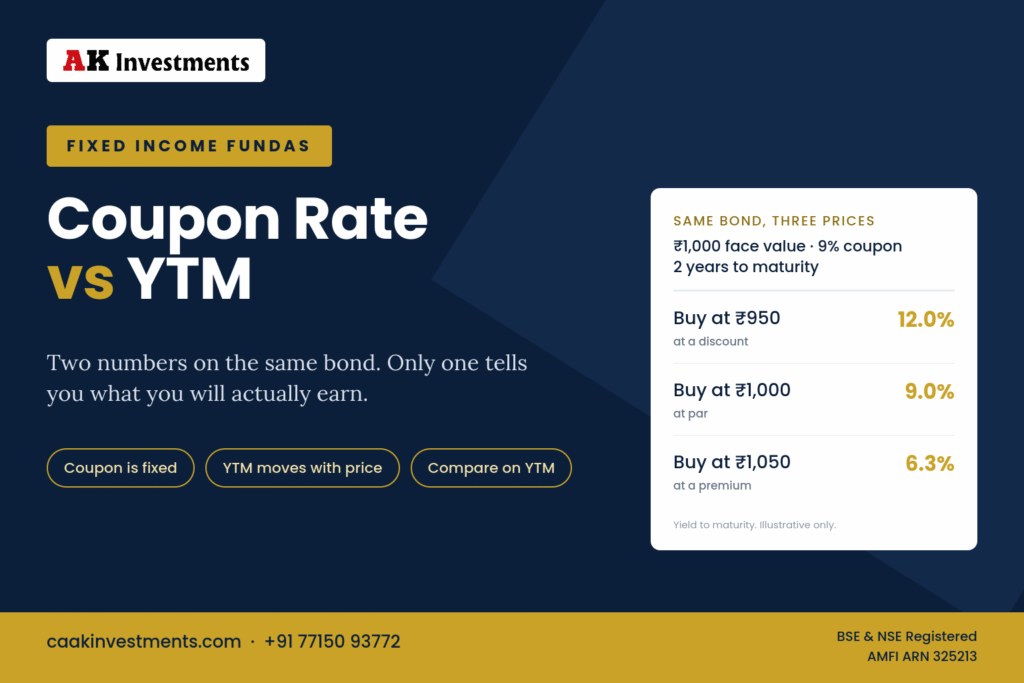
Consider a ₹1,000 face value NCD with a 9% coupon and two years left to maturity. Whatever you pay for it, it hands back the same ₹1,180 in total — two annual coupons of ₹90 each, plus ₹1,000 of principal at the end. Only the price of entry changes.
| Price you pay | Total cash you receive | Approx. YTM (p.a.) |
| ₹950 (discount) | ₹1,180 | 12.0% |
| ₹1,000 (at par) | ₹1,180 | 9.0% |
| ₹1,050 (premium) | ₹1,180 | 6.3% |
Illustrative example, assuming annual coupons and a clean purchase price. YTM is annualised and accounts for when each payment arrives, so it is not simply the total gain divided by the price paid.
Same issuer, same coupon, same maturity date. Three very different outcomes, decided entirely by the price on the day of purchase.
Why the coupon rate misleads
Nothing about the coupon rate is dishonest. It is simply answering a different question. The trouble begins when it is used as a headline, because a large number reads well in a forwarded message.
Two debentures may both advertise a 9% coupon. If one trades at a discount it might yield 11%; if the other trades at a premium it might yield 6%. An investor comparing coupons sees a tie. An investor comparing YTM sees the difference at a glance.
Three checks before you buy
- Read the YTM on the day you invest. Bond prices move with demand and with interest rates, so a yield quoted last week may not be the yield available to you today.
- Compare on YTM, never on coupon. Two NCDs of broadly similar credit quality and tenure should be ranked by yield, not by the interest rate printed on the instrument.
- Adjust for tax. YTM is a pre-tax figure. Interest on NCDs is taxed at your applicable slab rate, so two investors buying the same bond at the same yield can end up with quite different post-tax returns.
What YTM still does not tell you
Yield is the right basis for comparison, but it is not the whole picture. It is worth being clear about its limits:
- It assumes you hold to maturity. Sell earlier and your realised return depends on the price on that day.
- It assumes the issuer pays in full and on time. A visibly higher yield usually reflects higher credit risk rather than a bargain — read the rating and the issuer’s financials.
- The standard calculation assumes coupons are reinvested at the same yield, which rarely holds in practice.
- For staggered or amortising NCDs, where principal returns in instalments, the computation is more involved than the simple example above.
Yield tells you what you are being paid. The credit rating and the issuer’s balance sheet tell you why you are being paid it. Both deserve a look before you commit.
In short
The coupon rate tells you what the bond pays. The YTM tells you what you earn. When the two disagree, the second one is the honest number.
Frequently asked questions
Can the YTM be lower than the coupon rate?
Yes. That happens whenever a bond is bought at a premium to face value. You receive the same fixed coupon but paid more to acquire it, so your real return is lower than the coupon suggests.
Does YTM include capital gain or loss?
It does, and that is a large part of why it is the more reliable figure. Buy below face value and the yield includes the gain realised at redemption; buy above face value and it includes the loss. The coupon reflects neither.
Why does a bond’s YTM change after it lists?
Because its market price changes. The coupon is fixed for the life of the instrument, but once the debenture trades, its price rises and falls with demand and with prevailing interest rates. As the price moves, the yield moves inversely.
Do I need to calculate YTM myself?
No. Any regulated bond platform displays the YTM alongside the coupon, rating and maturity date. Understanding what goes into it simply helps you read the figure with confidence.
Is a higher YTM always better?
Not on its own. Between two bonds of comparable credit quality and tenure, the higher yield is the better deal. But a yield that stands well above the market usually signals weaker credit, so the rating and the issuer’s financials must be read alongside it.
What happens if I sell before maturity?
The YTM quoted at purchase no longer applies. Your actual return becomes a function of the price you receive on the day of sale plus the coupons collected until then, which may be higher or lower than the original yield.
YTM or coupon — which should decide my choice?
YTM. The coupon ignores the price you pay and can therefore flatter an expensive bond. The yield reflects price, interest and redemption together, which makes it the correct basis for comparing one NCD against another.
Compare live secured bond yields, ratings and maturity dates — and download a full repayment schedule — using the Bond Calculator at caakinvestments.com, or call AK Investments on +91 77150 93772.
Disclaimer
This note is issued by AK Investments for general information and investor education only. It is not investment advice, nor an offer or recommendation to buy or sell any security. Figures used are illustrative. Fixed returns are not guaranteed or assured. Investments in corporate debt securities, municipal debt securities and securitised debt instruments carry credit, market and default risks, including delay and/or default in payment. Read all offer related documents carefully before investing. AK Investments acts as a distributor of the products referred to here.
AK Investments | caakinvestments.com | +91 77150 93772 | BSE Reg. No. AP01673301178592 | NSE Reg. No. AP3086050151 | AMFI ARN 325213